





Eye For Film >> Movies >> Don't Let The Sun (2025) Film Review



Films featuring characters who are hired to pretend to be other people’s loved ones – a concept that is used by some real-life businesses in Japan – are something of an international trend at the moment. It might be more than a decade since Yorgos Lanthimos and Efthimis Filippou used it as the premise for Alps, but in the last couple of years it has also been the driver for UK-made surrealism-inflected In Camera and Austrian dark comedy Peacock. Now the premise is played completely straight by Swiss director Jacqueline Zünd in Don’t Let The Sun. While her background in documentary makes for rigour in terms of its naturalistic style, the story, co-written with Arne Kohlweyer, feels under-powered for its dystopian setting.
In a time not so very far in the future from ours, climate change has become catastrophic – a concept that seemed all too real for those catching this film at its world premiere at Locarno Film Festival, where the mercury sat in the mid to high 30s all week. In Zünd’s universe, the dangers have forced at least part of the world to become nocturnal, including the children, who are schooled at night. Locked off, measured shots of sunrise and the empty streets emphasise the sense of isolation – sure to strike a chord with audiences after the recent history of Covid lockdowns – as though the sun has left everyone parched of joy.

As an exercise in world building, Zünd nails a vibe of general otherworldliness not just in that reserved shooting style but by having her multinational cast all speak English, so that the geographical placement of the film is indeterminate.
Jonah (Levan Gelbakhiani, And Then We Danced) is a chameleon in this environment, slipping into various roles dictated by his employers. Chief among them is working for Cloe (Agnese Claisse) a single mother who has hired him to act as a father figure for her daughter Nika (Maria Pia Pepe) in a bid to help the pre-teen become less reclusive.
Nika, however, doesn’t want to play the game. “I don’t need a father,” she tells him, although the skateboard he gifts her quickly becomes part of her routine. What people need – a genuine connection – is at the heart of Zünd’s film as we see this isn’t the only job Jonah is contracted to in a day that will also see him take part in a strange bare-chested cross between hugging and wrestling class as part of his routine.
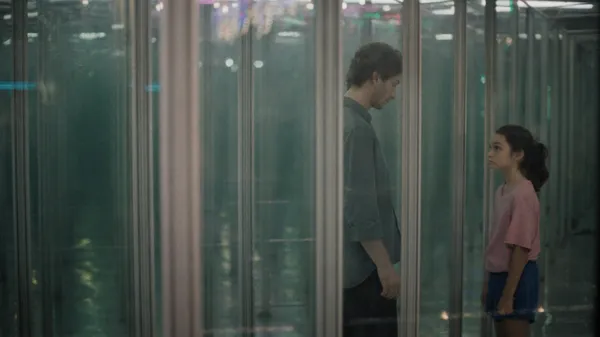
As a relationship begins to be forged between Nika and Jonah, the question becomes not how much she needs him but to what extent the reverse may be true. While the film’s narrative trajectory may not quite deliver all that is promised, Zünd has a strong control of mood. She also uses architecture and reflections to emphasise the film’s broody atmosphere – from the hive-like stairs we see Jonah climb repeatedly to the maze of mirrors he takes Nika to. It may not build to a scorching finale but Don’t Let The Sun has slow-burn charisma.
Reviewed on: 31 Aug 2025